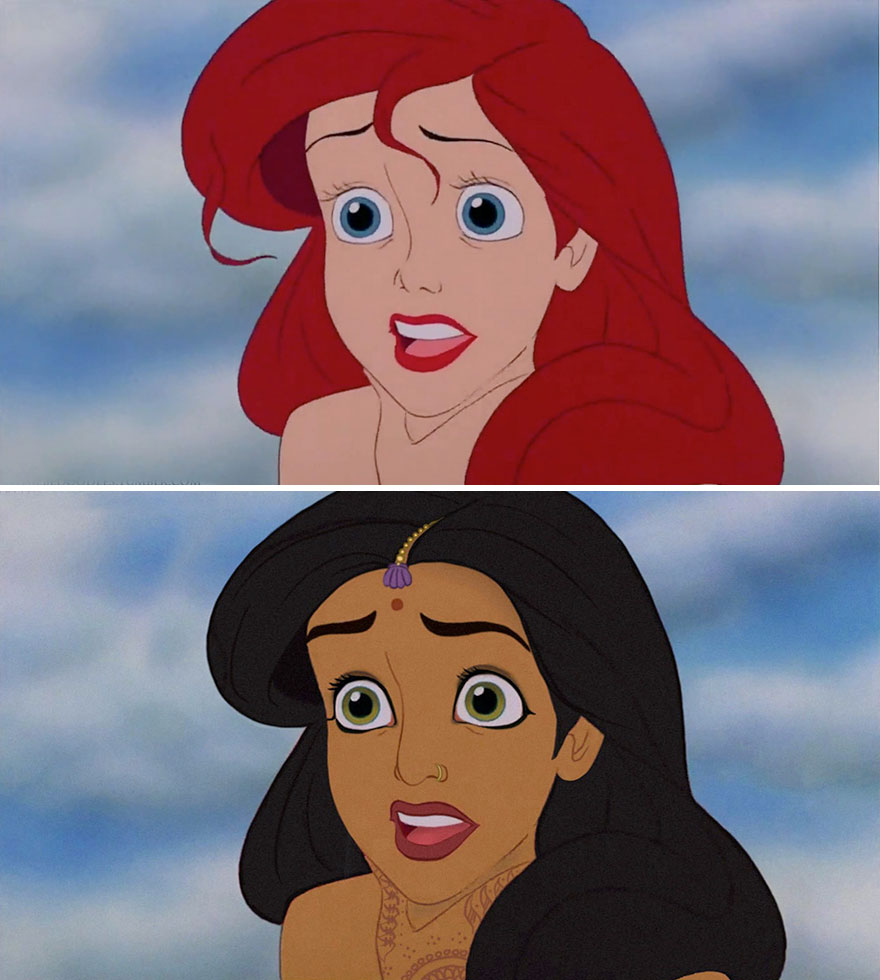
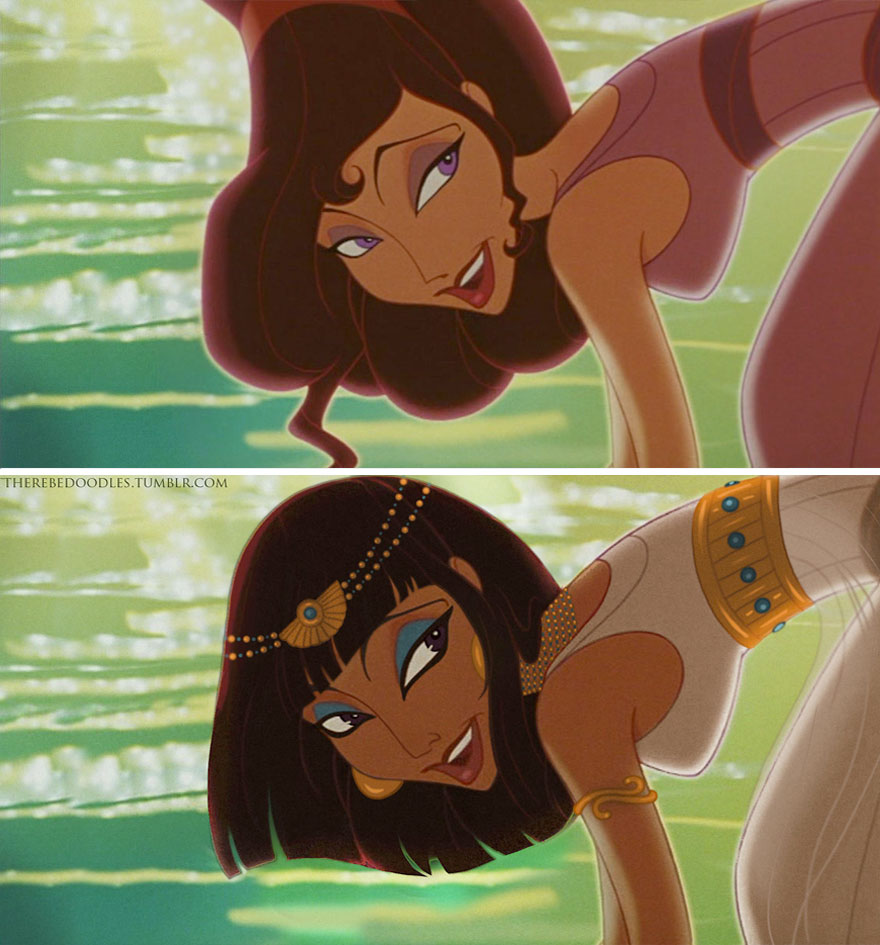
My friend and I were talking about an article we saw where an artist had reimagined Disney heroines with different ethnicities. Here is the artwork in question:
 |
| Cinderella gives her opinion. |
Honestly, it's not even the most controversial or unusual fan art on the Internet. If you glance online - you don't even have to search very hard - you can find countless examples of this type of thing. I can almost guarantee that every character you've ever cared about has been reimagined with a different ethnicity, sex, species, or age, set in the wrong time and / or place, dressed in a strange costume or no costume at all, coupled with a new love interest (possibly someone from an unconnected story universe), and any other thing your heart could hope for. And that's just the artwork, to say nothing of literary fan fictions. It's what people do. Good stories will awaken creativity. Good story telling makes people want to join in.
I maintain that these experiments are mostly done for fun, but I am going to contradict myself little a bit: I think my angry friend is partially correct.
Like her, I did notice that while all of the princesses were changed, none of them were changed to Caucasian, I simply wasn't offended by this. It's been said that no choice is made without some conscious or unconscious reason behind it. If there is a take away message from this project, perhaps it is that we could do with more variety in pop culture. Maybe the artist wanted people to start imagining things in ways we're not used to, regardless of tradition, and see what we can come up with, including but not limited to getting comfortable with seeing dark skin and non-European cultures.
My friend said there was no need to make children's characters into a political platform, but I say there absolutely is a need for this type of thinking, and using beloved children's characters is a great way to get the message out there. If people are changing the stories and characters we're used to, it's because they lack something the fans are looking for. One question that my friend failed to ask is why so many more European stories were represented than other stories, and what affect this lack of representation may have on our society.
What if you were not represented in popular fiction? By that I mean, what if almost every imagined definition of beauty, icon of heroism, or wholesome image of a boy or girl next door had nothing to do with how you look? When everyone is white, it means that people of color aren't beautiful, or heroic, or smart, or relatable. It means they're not worth mentioning at all.
I remember being a little kid in the 80s and noticing that not only was almost everyone on TV white like me, but often the good guys were blond while the bad guys had dark hair and olive (though pale) complexions. Notable exceptions resided on Sesame Street and the Cosby Show.
I don't want to sound like I had some precocious understanding of race relations. Maybe a little, but mostly I had a self-centered desire to be unique. I remember being sick of my appearance by the time I was 8 because everywhere I looked I saw blond white people. I felt like a cliche before I knew the word, which is much better than feeling like I don't exist but I still found it unpleasant.
I think that part of why I noticed this lack of diversity is because I'd been reading a comic series called ElfQuest for years. The pages were full of colorful images of beauty and adventure, and to me there was no one - no Disney princess, pop idol, or movie star - who was more perfect than Wendy Pini's Leetah. In addition to being beautiful, she was compassionate, brave, purposeful, intelligent, and very protective of her independence. I loved her. I still want to grow up to be her.
 |
| Elfquest art copyright Warp Graphics, Inc. Elfquest, its logos, characters, situations, all related indicia, and their distinctive likenesses are trademarks of Warp Graphics, Inc. All rights reserved. |
< What went here? Introduced whitewashing... >>
You can find examples of Hollywood whitewashing here and here (and lots of other places, like your TV). We expect this type of thing from the olden days of racisms gone by, but it's shocking how often it still happens today.

For instance, I recently learned that the casting call for the lead role in The Hunger Games asked for Caucasian females only, despite Katniss being described in the books as having olive skin and dark hair. While Caucasians can fit that description, so can a lot of other people. I think Jennifer Lawrence was a great choice and I'm not sad about it, but I also think this was a missed opportunity. People of color seem to be particularly under-represented in the sci-fi and fantasy genres, and who's to say there wasn't a darker skinned Katniss out there who would've been just as good or even better than Jennifer Lawrence? They didn't even look for her.
Well, most of them do. There was a big uproar when the Hunger Games movie came out and little Rue was found to be black, despite her being described as having dark brown skin in the book. And I'm not talking about, "Huh, I didn't realize Rue was black, did you? I must've overlooked that." I mean some really ugly business.
The Hunger Games is far from the only example of whitewashing from recent film making. When a live action version of the popular cartoon Avatar: The Last Airbender was cast, many fans noticed something fishy:
 |
| Source: http://colorlines.com/archives/2010/07/whitewashing_of_hollywood.html |
It's tempting to say that whitewashing doesn't matter, and I'll agree that there is the potential to get too picky. For example, it doesn't offend me if an actor is a different variety of Asian than the character he plays any more than when a Canadian actor plays an American character, but it does bother some people. Changes are often made to characters in order to accommodate the actors. They changed the character history of Mark Thackery in the movie To Sir, With Love to explain Sidney Poitier's American accent. Vivien Leigh, who played Scarlett O'Hara in Gone with the Wind, was not an American southern belle. She was British, so she had to use acting to become a southern belle. Furthermore, they used movie magic to change her eyes to green. Should skin color or ethnicity matter any more than Vivien Leigh's eyes in Gone with The Wind? And isn't acting pretending, anyway? Maybe sometimes an actor can fit a part even if his ethnicity doesn't. Why should it matter?
It matters because it's not equal. Saying that looks are secondary to a character's nature or personality is fine. However, when there's a pattern of changes to looks only going one direction it's not ok. If we were just as likely to see a black actor in a role that was written white as the other way around maybe it wouldn't matter, but that's not the world we live in. There's got to be a reason for that, and it can't be a very good one.
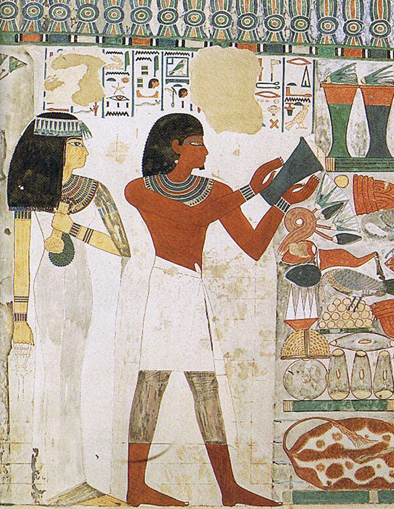
It also matters because it's like saying, "We like everything about you except for you." The African queen Cleopatra is an appealing character for a movie. She was rich and beautiful and powerful and interesting... we better cast a white lady so that she's glamorous enough, or relatable enough, or just so that we're comfortable looking at her. We'll take all the parts of her and give them to this white lady to make them better. Once when I was a freshman in high school... << tell appropriation story >>
Not many people notice when a dark skinned character is lightened but when the shoe is on the other foot it suddenly seems to matter. When the actor Michael B. Jordan was cast as the Human Torch, there was an uproar, and that's not the only time this has happened. Check out this clip from Donald Glover's stadup special Weirdo from 2012 (but watch out for F words if you're sensitive to those things):
<< weirdo clip >>
Hollywood isn't the only group who whitewashes. Please read this interesting and fantastic article about YA book covers. Furthermore, think of the magazines you see at the grocery store. Magazines with white people on the cover are for everybody, but magazines with black people on the cover are for black people because white is the default normal thing to be and anything else is specialty interest. Often when black women are cover girls, they get whitewashed in another way: the beauty whitewash. Have a look:


 |
| Tiana does not see the need for this. |
I was really excited when I heard that Disney was going to give us a black princess. I was worried that they'd make her fair skinned or give her European features. Obviously there's nothing wrong with having fair skin and European features (whether you're a woman of color or not), but this was going to be the first black leading lady from Disney and I wanted her to be very obviously black. I wondered how her prince would look, too. Would a black prince say, "She's nice, but we still can't mix with each other?" Would a white prince say, "We'll give you the black heroine, but a black hero is asking too much?" I was thrilled that Prince Naveen was dark skinned, but not darker than Tiana. We have a weird habit of associating fair with feminine. Ancient art from all over the world depicts couples where the female is pale and the male is darker. We still think that way. There's a book about it. If you don't believe me, do a Google image search for, "Disney kiss." Of course, as frogs it was reversed (that's a trope), but as people she is darker, and that is a victory.

I could go on and on about this, and I'll probably bring it up again in the future, but for now I'd like to end on a quote from a commenter on the This Could Have Been Frozen blog:

"Figure out why you're upset about dark people in your 'white' fairy tale and not the lions in your Hamlet."


